Start of project: Winter semester 2021/22
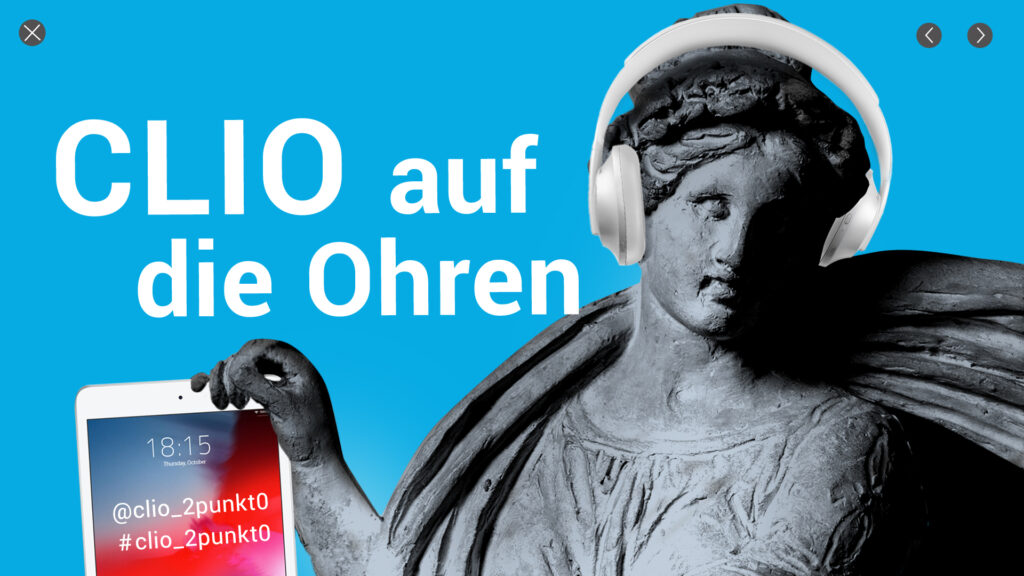
“Clio auf die Ohren” is the name we settled on to tackle a new format in the winter semester 2020/21: podcasting. Our first topic was not far-fetched: pandemics and epidemics in world history. We started a new chapter with our second season: this podcast series, which started as a project-based teaching format with students in the winter semester 2021/22, is dedicated to migration and mobility, particularly in the 20th century. The podcasts were made public starting in the summer semester of 2022.
Advanced seminar Longitudinal Perspective of International History | Summer semester 2022 (Hauptseminar Längsschnitt/Internationale Geschichte)
In this project on Russian-German lives, the presented lives were first reconstructed in museums and digital forms of presentation. Then, student podcasts about Russian-German history were created on this basis.
A Modern History practice class in the winter semester 2022/23 was designed as a follow-up and aimed to create a small virtual exhibition on the history of Russian-German biographies in the Rhine-Main area. However, despite some findings, the exhibition could not be realized in the end.
Advanced seminar Longitudinal Perspective of International History | Summer semester 2022 (Hauptseminar Längsschnitt/Internationale Geschichte)
Political maps with large areas of the same color suggest that the respective territories were uniformly affiliated with a specific state – an idea that is not an accurate portrayal of the pre-modern era. In this project, students worked with employees from the DigiKAR research project to create modern and more appropriate virtual maps of the Holy Roman Empire. The focus was on the mobility of the Electorate of Mainz elites and their influence on spatial territories.
Advanced seminar Longitudinal Perspective of International History | Summer semester 2022 (Hauptseminar Längsschnitt/Internationale Geschichte)
In the project seminar “Transnational Mainz of the 1960s/70s”, the Department of History topic “Migration and Mobility” was examined on a local level. The starting points were image sources from the Mainz City Archive (including the new collection of the former AZ photographer Karin Eckert, which has hardly been evaluated to date). These were professionally evaluated, contextualized, and linked to overarching questions. The project aimed to develop a practice-oriented presentation of selected findings in the form of an internet-based interactive exhibition.
Advanced seminar Longitudinal Perspective of International History | Summer semester 2022 (Hauptseminar Längsschnitt/Internationale Geschichte)
Immigration represents a particular challenge for societies with a claim to historical-cultural self-understanding. In this advanced seminar, students first reconstructed the difficulties of establishing an immigration museum or even a corresponding collection in the Federal Republic of Germany, then examined immigration museums in other countries. The course ended with a field trip to Israel to trace the museumization of the German-Jewish immigration of the “Jeckes”. Impressions and findings were recorded in student podcasts.
Modern History practice class | Winter semester 2022/23 (Übung Neueste Geschichte)
Photographs from around 1900 on the structural situation and life in Mainz are rare. The Mainz City Archive recently acquired photographs from the late 19th and early 20th century, expanding the photographic material available for this historical period marked by development and upheaval. In the practice class, the photographic material was professionally evaluated, and the students shot a film presenting the material to the public. The project was also mentioned in the cultural committee of Mainz.
Modern History practice class | Winter semester 2022/23 (Übung Neueste Geschichte)
In this practice class, students created the first Digital Mainz Women’s Calendar in the tradition of the existing Mainz Women’s Calendar. In this context, they also gave a face and a life story to pre-modern Mainz women for the first time.
Start of project: Winter semester 2022/23
This multi-era project marks the start of the third season of the podcast series “Clio auf die Ohren”, which focuses on environmental and climate history stories.
Advanced seminar Longitudinal Perspectives on International History | Summer semester 2023 (Hauptseminar Längsschnitt/Internationale Geschichte)
In this seminar, the diversity of the late Russian Empire was reconstructed in the first color photographs shortly after 1900 and depicted in a virtual exhibition with the help of these very photographs.
Advanced seminar Longitudinal Perspectives on International History | Summer semester 2023 (Hauptseminar Längsschnitt/Internationale Geschichte)
In this advanced seminar, questions of conflict and peacemaking in the late Middle Ages in a regional context were reconstructed and visually processed.
Advanced seminars Longitudinal Perspectives on International History | Summer semester 2023 (Hauptseminare Längsschnitt/Internationale Geschichte)
The end of an empire is traditionally given great macro-historical significance. It is often regarded as an epochal boundary and turning point. Far less attention is paid to the micro-historical side of these changes of rule, i.e., what such an event meant for people who lived there. In two related advanced seminars, questions related to this topic were examined using the example of Mainz for the two epochal periods of upheaval in 1797/98 and 1918/19.
Practice Class Medieval History | Winter semester 2023/24 (Übung Mittelalterliche Geschichte)
Coats of arms were omnipresent in the Middle Ages – they could be seen on castles, at town gates, in churches, town halls and inns, on silverware, wine barrels, on and in books as well as on shields, tabards, pennants, and banners. As part of this practice class project, the coats of arms of the “Oppenheim Ratsrose” were reconstructed from a historical perspective. A digital publication is currently being prepared.
Practice Class Modern History | Winter semester 2023/24 (Übung Neuere Geschichte)
Pregnancy and birth are among the topics to which women’s history turned its attention early and intensively. In this project-based practice class, a digital edition on midwifery in the city of Mainz was developed.
Start of project: Winter semester 2023/24
How does historiography respond to challenges that are not part of our fields of work in forms of media that we have not learned from scratch? In this project, short climate history videos were created for Instagram, Tiktok and YouTube Shorts for all eras.
Advanced Seminar Modern Era | Winter semester 2023/24 (Hauptseminar Neuzeit)
In this project-based advanced seminar co-opted into Modell-M, selected war memorials from the First and Second World Wars in Mainz were examined. A digital publication is in progress.
Practice class Ancient History | Winter semester 2023/24 (Übung Alte Geschichte)
This Ancient History practice class on material sources from antiquity, which is firmly anchored in the bachelor’s curriculum, was the first to use media in this way and was financially supported by the GLK. Audio clips were produced that can be integrated into virtual city tours through the Mainz of antiquity.
Jun.-Prof. Dr. Christian Bunnenberg (RUB Bochum): Von @ichbinsophiescholl und @krieg7071. Geschichte auf Instagram und Twitter als geschichtskulturelle Praxis und Perspektiven für die historisch-politische Bildung
Monday, 17 January 2022, 6 to 8 pm | Lecture and discussion
Prof. Dr. Thorsten Logge (University of Hamburg): Projektlehre im Geschichtsstudium – lokal, regional, digital
Monday, 5 Dezember 2022, 6 to 8 pm | Lecture and discussion
Dr. Nico Nolden: Public History und digitale Spiele
Thursday, 19 January 2023, 6 to 8 pm | Lecture and discussion
Janine Funke (Terra X History Podcast): “… was mit Medien”: Professionelle Geschichtsvermittlung im Podcast
Thursday, 6 July 2023, 6 to 8 pm, P 10 (Philosophicum) | Lecture and discussion
Wednesday, 24 May 2023, 2 to 5 pm || Fakultätssaal (Philosophicum)
Participants: Department of History, University Library Mainz Mainz, Institute of European History, Academy of Sciences
Wednesday, 29 June 2024 || Institute of European History (IEG), Conference Room
More to follow

