ModeLL-M is one of 139 projects funded across Germany by the foundation „Innovation in der Hochschullehre“ as part of the call for proposals „Hochschullehre durch Digitalisierung stärken“ (2020). During the project period (August 2021 – July 2024), models are to be developed that demonstrate how key factors for student-centered teaching and learning can be strengthened by combining digital elements and face-to-face formats, including:
- Successful activation in different learning environments, especially in time- and location-independent learning.
- Scenarios, formats, and learning environments that enable students to practice self-management and experience self-efficacy.
- Designing teaching-learning scenarios that encourage students to collaborate and actively support constructive interaction with fellow students, including through the use of digital tools.
In this context, the Department of History is dedicated to the model area of digitally extended project-based learning. The term “project-based learning” refers to a form of teaching which is based on scientific results and focused on action and in which students work on academic problems and questions both independently and in groups. Members of the teaching staff accompany the project and instruct the students. The teaching method represents a paradigm shift from teaching to learning. It is a response to the requirements of the Bologna reform for more practical relevance in programs of study and aims to improve the employability of students.
The Community of Practice “Digitally enhanced project-based learning” in the subject of History is supported by a group of experienced members of the teaching staff who have already tried out new approaches in the field of project teaching with great commitment and have now made professionalization in this university didactics segment their concern. The Community will be expanded to include students. The sub-projects are linked in a structured way from the planning to the evaluation phase, with the CoP paying particular attention to the constant exchange of experience and joint problem-solving, the integration of external expertise, and the management of project-based learning. The aim is to further professionalize the CoP as part of a Scholarship of Teaching and Learning in project-based learning as well as the curricular integration of project-based learning.
Digitally enhanced project-based learning is a form of teaching that leads to the development of unconventional results, such as digital forms of presenting and engaging with history. The aim is the specialization of subject-specific problem-solving skills.
#Klimageschichten im #Klimawandel: Vortragsreihe mit Kurzclips
Projektlehre: Wie Historiker:innen arbeiten. Einblicke in die Projektlehre im DigiKAR-Projektseminar
Projektlehre: Mobilität in Kurmainz: Digitale Karten des frühneuzeitlichen Mainz
Clio auf die Ohren: Migrationsgeschichten. Studierende podcasten Geschichte
Previous experience: In the past, the Department of History has carried out various teaching projects, often analog, aimed at products such as an exhibition or guided tours. Projects are product-oriented, risky, and open-ended.
Digital expansion: As a result of the pandemic, such projects had to be realized digitally – reinforcing an existing trend. Researching and teaching history are increasingly taking place in a digitally enhanced or purely digital format. Students also work in digital networks, and external experts are brought in to answer complex questions.
Sustainability: We want to transfer these experiences to post-pandemic teaching, develop them productively, and sustainably anchor them in the teaching curriculum.
Previous experience: We had already gained initial experience with digital products before the pandemic – for example, by complementing exhibitions with QR codes that led to further web-based information. During the pandemic, ideas such as the production of podcasts and web clips were added, which were successfully realized, for example in the form of a podcast series on pandemics and epidemics in world history.
Digital expansion: We now want to expand this range of digital products – and operationalize it as a “toolbox” to be used widely. In a first step, we are focusing on:
- student-produced podcasts: expert interviews, biographical research that can be incorporated into a virtual exhibition, or scripted thought processes discussing complex subject-specific issues;
- digital maps for the visualization of epoch-specific spatial perceptions and mobility patterns;
- virtual exhibitions with a critical focus on the digitized source materials.
Digitality as a booster: While project-based learning with digital components is incredibly motivating for students, it also has a lot of subject-specific activation potential. In this way, digitally enhanced project-based learning opens up new depths of subject-specific thinking and promotes the desire to study history as well as students’ general employability.
The further development of degree programs and the design of courses and forms of examination (constructive alignment) have always been an important concern for historians; the fact that the famous methodologist Ernst Bernheim (author of the history textbook “Lehrbuch der historischen Methode und der Geschichtsphilosophie”) was also one of the first university didactics experts is just one example of the long tradition didactic reflection has in the subject of history.
With this in mind, the Department of History in Mainz is also continuously working on the further development of learning and teaching.
This page tells you about the didactic issues we are working on; if you are interested in similar topics, please feel free to contact us!
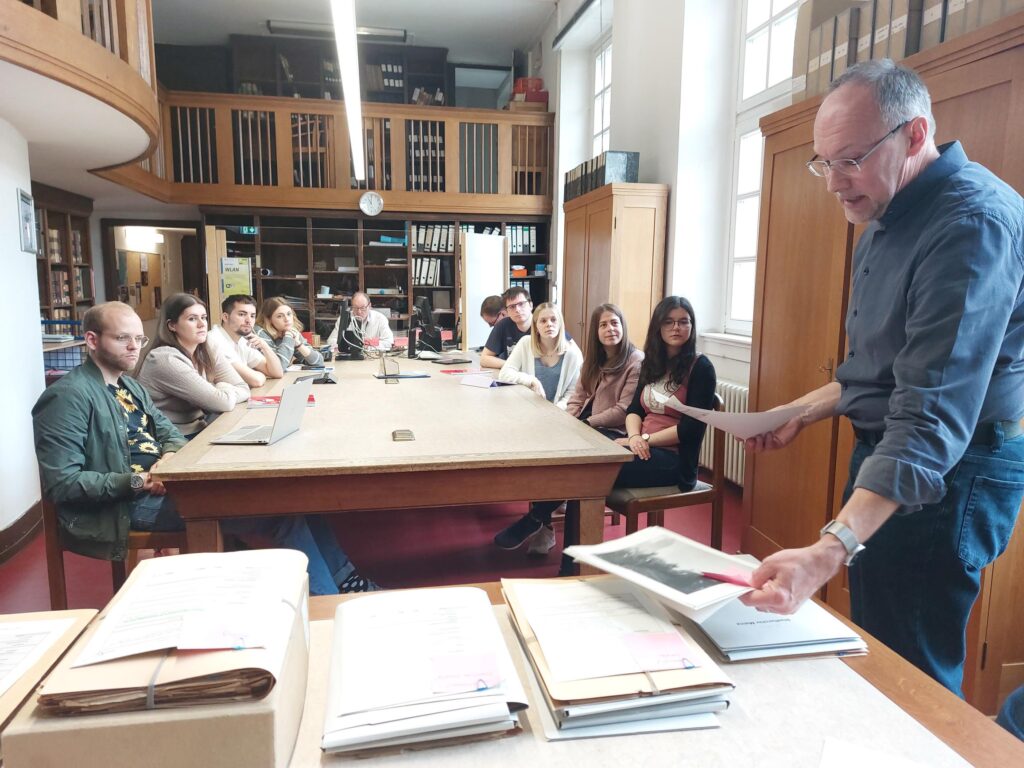
The entry phase plays a central role in university didactics discussions. The Department of History intends to empirically survey the structural obstacles to learning students face in the entry phase of their study of history and develop considerations for a preliminary and/or accompanying offer for students in this phase. Since programs of study are always situated in specific faculties, factors that hinder or inhibit learning can only be surveyed on a subject-specific basis; however, the Department of History will carry out their empirical survey using methods that can easily be adopted by other faculties, at least by other humanities and social sciences subjects. The procedure includes the descriptive-statistical evaluation of term papers in introductory seminars according to agreed-upon evaluation criteria. This database is to be supplemented by an evaluation of CampusNet reports. Following a “decoding the bottlenecks” approach, guided interviews with teaching staff in the initial phase of the program of study and analyses of student narratives will also be conducted. In a third step, suitable measures and structures will be developed to support students in remedying these deficits.
This project is financially supported by the Gutenberg-Lehrkolleg.
Case studies are a widespread and, above all, fundamental teaching format in the subject of Economics at universities globally, but especially at international business schools. Case studies have been used in teaching and learning at US law schools since the 1870s. The renowned Harvard Business School adopted the approach as its central teaching format in the 1920s – and in a way that is highly remarkable for German historical studies: In Germany, case studies are often understood to be designed to formulate solutions and approaches to concrete and, above all, present or even future problems – but case studies at Harvard Business School are based on history! Using historical case studies to teach is not a widespread practice in the study of history in Germany – yet. This project aims to change that. As part of the project, historical case studies on globalization, entrepreneurship, consumer orientation, and much more will be tested for use in teaching.
Contact:
Jun.-Prof. Dr. Eva-Maria Roelevink (eroelevi@uni-mainz.de)
The term paper continues to be the core objective of undergraduate degree programs in history. All the methodological and didactic developments in historical studies in recent years have not fundamentally changed this. Writing this work is still considered an integral part of the program of study („das A und O des Studiums“ (Birgit Emich)). Term papers are considered the pinnacle for students of history („Königsdisziplin (…), die eine entsprechende Heranführung der Studierenden an dieses komplexe Format notwendig machen“ (Rainer Pöppinghege)).
This workshop, which continues the joint reflections of the didactic writing workshop in Bielefeld in March 2018, aims to shed light on the skills needed to successfully write a term paper from different perspectives. It offers historians and those who teach writing the opportunity to exchange ideas about specific methods for teaching historical writing and/or didactic writing elements in history courses. Tasks and teaching methods, curricular decisions, writing didactic interventions and measures can be presented, tested and reflected upon in a collegial setting. Mainz students will be actively involved in the discussions; participants are also welcome to bring along interested students.
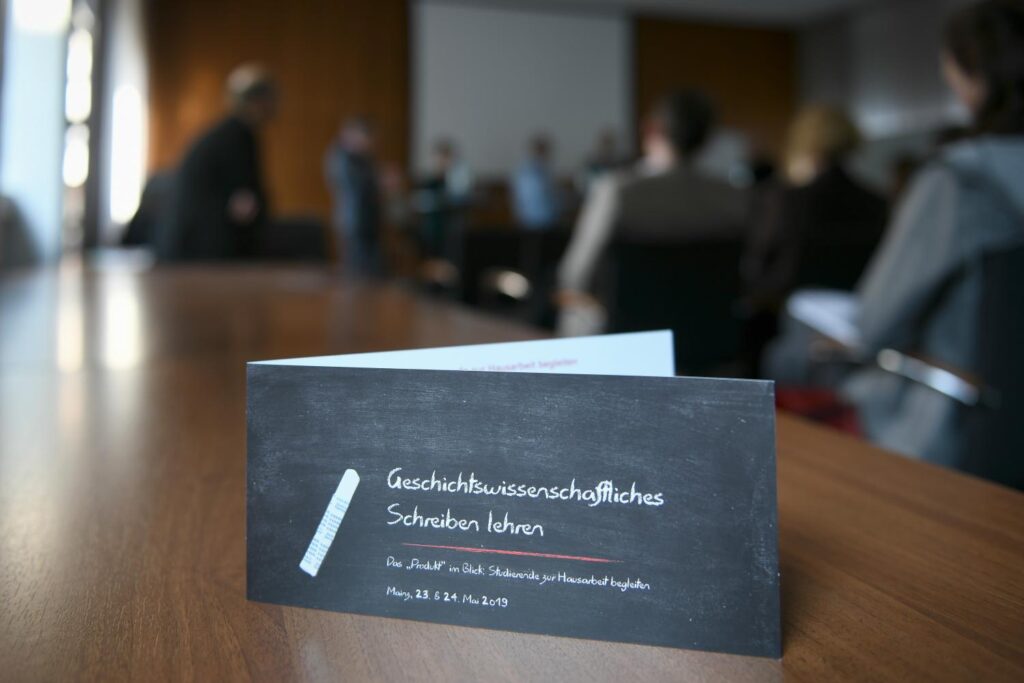
Date & location
Thursday, May 23, 2019, and Friday, May 24, 2019, Johannes Gutenberg University Mainz, Jakob-Welder-Weg 18 & 20, 55128 Mainz, Germany
Organizers
Dr. Andreas Frings, Dr. Heidrun Ochs
Program
Donnerstag, 23. Mai 2019
Podiums-Diskussion, Fakultätssaal,
Philosophicum I
Participants
- Eric Beres (SWR | Report Mainz)
- Björn Gebert (ULB Münster, subject librarian and co-editor of the science blog “Mittelalter”)
- Jürgen Heimbach (Author)
- Heather King (JGU, student)
- Anna Kranzdorf (JGU, Personal Assistant to the President)
- Lara Luisa Storch de Gracia Asensio (JGU, student tutor)
Moderation
- Dr. Jan Kusber (JGU | Department of History)
Freitag, 24. Mai 2019
Workshop, Besprechungsraum im EG des Philosophicum II
9.00 Uhr – Raoul Hippchen | Mainz
Seminararbeiten und andere Probleme. Empirische Forschungen zu Herausforderungen in der Studieneingangsphase
9.45 Uhr – Maik Schmerbauch | Berlin
Probleme bei grundlegenden (geschichts-)wissenschaftlichen Arbeitsweisen
10.30 Uhr – Pause
11.00 Uhr – Friederike Neumann | Bielefeld
Alles oder nichts oder was? Zur Auswahlproblematik in der kompetenzorientierten Lehre
11.45 Uhr – Hiram Kümper | Mannheim
Geschichte in Leichter Sprache
12.30 Uhr – Mittagspause
14.00 Uhr – Angela Siebold | Frankfurt
Schreibvermittlung im Grundstudium
14.45 Uhr – Susanne Korbel | Graz
Am Weg zur Seminararbeit: Essays zum Finden der eigenen Historikerstimme
15.30 Uhr – Kaffeepause
16.00 Uhr – Marlen Fies, Ulrike Pospiech & Claudia Spanier | Duisburg-Essen
Geschichtswissenschaftliche Seminararbeiten mit dem FöBesS-Raster feedbacken
16.45 Uhr – Schlussdiskussion
There was quite a lot going on at the faculty’s “Day of Teaching” on July 5, 2017: Initiated and conceived by Anne Brandstetter (Cultural Anthropology), Thorsten Hindrichs (Musicology) and Andreas Frings (History), seven courses and teaching projects from the faculty’s historical and cultural studies subjects presented their professional approaches and impressions of teaching on and with migration history topics. Why the focus on migration in particular? Because the intent was also to point out the social relevance of the subjects – but even more about how topics that we consider to be relevant in the present are often omnipresent historically anyway and have thus always been part of our research and teaching – a topic that can also be used to demonstrate the value of historical and cultural studies differentiation. In any case, the Day of Teaching set such a high standard, also in discussions at the tables, that the Dean’s Office is considering repeating it next year. A panel discussion with Hans-Christian Petersen (History), Heike Drotbohm (Cultural Anthropology), Gesa zur Nieden (Musicology), and Christine Walde (Classical Philology) rounded off the day with a reflection on teaching situations and teaching decisions from a subject-specific and didactic perspective.
The photos shown here were taken by Andreas Linsenmann, to whom we are very grateful.
Digitization is currently one of the greatest challenges for university teaching. On the one hand, this challenge is particularly important for historical studies, as methods of knowledge development and source criticism are at the core of the subject of history and affect its very identity. New tools and technologies bring with them new theoretical and methodological problems and change the institutions of memory that are central to historians. On the other hand, students today come to university with completely different experiences and backgrounds. They use digital methods and resources as a matter of course, but often without the basic skills to classify and evaluate them. This twofold challenge is countered by a lack of subject-specific university didactics training and further education for teaching staff.
This project has therefore set itself the goal of improving the teaching of skills in the use of digital methods in a sustainable and future-oriented manner in three steps: Reflection on the current situation, training and further education of mid-level academic staff, and development of a cross-epochal concept for the use of digital items in history teaching at the Department of History.
In conjunction with other disciplines at JGU, the Department of History offers courses designed to meet the specific learning needs of exchange students. These two-hour courses with changing topics every semester semester are supplemented by two-hour tutorials that introduce students to the basics of academic work in a German-speaking university context.
Contact and more information: Dr. Pia Nordblom.
The Department of History has long been offering research-oriented teaching projects on a wide variety of topics from all eras in order to meet the motivation and commitment of students and to demonstrate historical scholarship beyond the subject-specific paths of a term paper. The Dies Legendi of the Gutenberg Teaching College in October 2015 gave the Department of History, along with the other subjects at Faculty 07, the opportunity to present a selection of these projects to a broader public interested in learning and teaching. Here are some snapshots from this event:
The three posters of the Department of History can be found here:
- Die Rote Armee Fraktion (RAF) – Ein deutsches Trauma?
- Germanistisch-Historischer Arbeitskreis – Arbeit an mittelalterlichen und frühneuzeitlichen Originalhandschriften in der Region
- Osmanisch-deutsche Verflechtungen und die Armeniergräuel im Ersten Weltkrieg – ein Ausstellungsprojekt zum Völkermord an den Armeniern
Organizers: Dr. Andreas Frings, Dr. Christine Kleinjung, Dr. Andreas Linsenmann
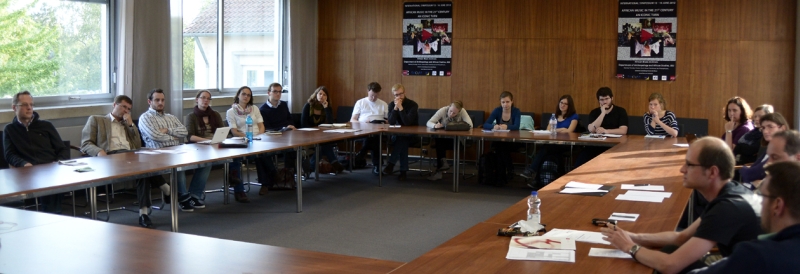
Introductory seminars are considered a central element in the program of study in History, as they are characterized by a pronounced focus on skills: In them, students should be given the technical and subject-specific skills required for academic papers. The catalog of skills to be taught is continuously adapted and further developed. This is where the teaching project comes in. It aims to offer teaching staff sustainable impulses for reflection and knowledge. By systematically integrating the students’ perspectives, the project also aims to raise awareness among teaching staff and improve the compatibility of the perspectives of both sides. To this end, three events were held in the 2012 summer semester to promote reflection and discussion. In the winter semester 2012/13, the transfer into practice followed, flanked by forms of collegial exchange and competence-oriented surveys in the introductory seminars. There were also surveys on students’ self-images and role expectations, which in turn were incorporated into the teaching methods. We plan to publish the results of the project.
Student Assistants: Jelena Menderetska, Aline Breuer
Contact
Project manager: Dr. Andreas Frings
Since the end of 2012, the Department of History has continuously expanded the services of its academic advisory office, aligning them with the needs of history students in the various phases of their studies, as well as the transition phases between school, university, and the transition to a profession. Individual advising is accompanied by information events, mentoring offers and professional orientation measures. Further steps are planned for the second project phase from 2017–2020:
Measures (selection)
- Establishment of peer-to-peer workshops for exam preparation in the first academic year
- Establishment of an (extracurricular) subject-specific offer for master’s degree students
- Internationalization at home, including accompanying and supporting (international) student conferences
- Extension of introductory seminar tutorials through writing support in peer learning
- Expansion of the range of events for career orientation
If you have any suggestions, please contact Dr. Freia Anders directly.
LOB project, funding code 01PL17055: This project is funded by the federal ministry of education and research under the funding code 01PL17055. The author is responsible for the content of this publication.

JGU won the 2009 Rhineland-Palatinate Teaching Excellence Competition with its concept for the strategic direction of teaching and further development of teaching skills (“Strategischen Ausrichtung der Lehre und Weiterentwicklung der Lehrkompetenz an der Johannes Gutenberg-Universität Mainz”). At the heart of this concept is a comprehensive university didactics approach, which was initially tested in the subjects of Biology, German Studies, and History. The aim is to further develop teaching skills with the help of university didactics courses and to grant the opportunity for collegial exchange (both within and across disciplines) on teaching issues in order to do justice to the simultaneity of individual and collective responsibility for teaching. The program spanned three semesters and was essentially composed of the following program elements:
Workshops
University didactics principles for implementing the “shift from teaching to learning”
Specialization in subject didactics in line with the topics requested by the participants
Disciplinary work shadowing
Individual, practical implementation of the course content
In groups of two, one session per member of teaching staff: preliminary discussion, mutual attendance at sessions (by mutual agreement), and debriefing
Collegial practical advice
Discussion of experiences on tandem work
Forum for overarching and situation-specific teaching issues
Interdisciplinary presentation training
Basics of presentation design, breathing, speaking, and body language
Own presentation with video recording and collegial feedback
Interdisziplinary work shadowing
Mutual course visits in groups of three members of teaching staff with subsequent feedback to the lecturers
The individual elements are regularly evaluated for quality assurance purposes.

